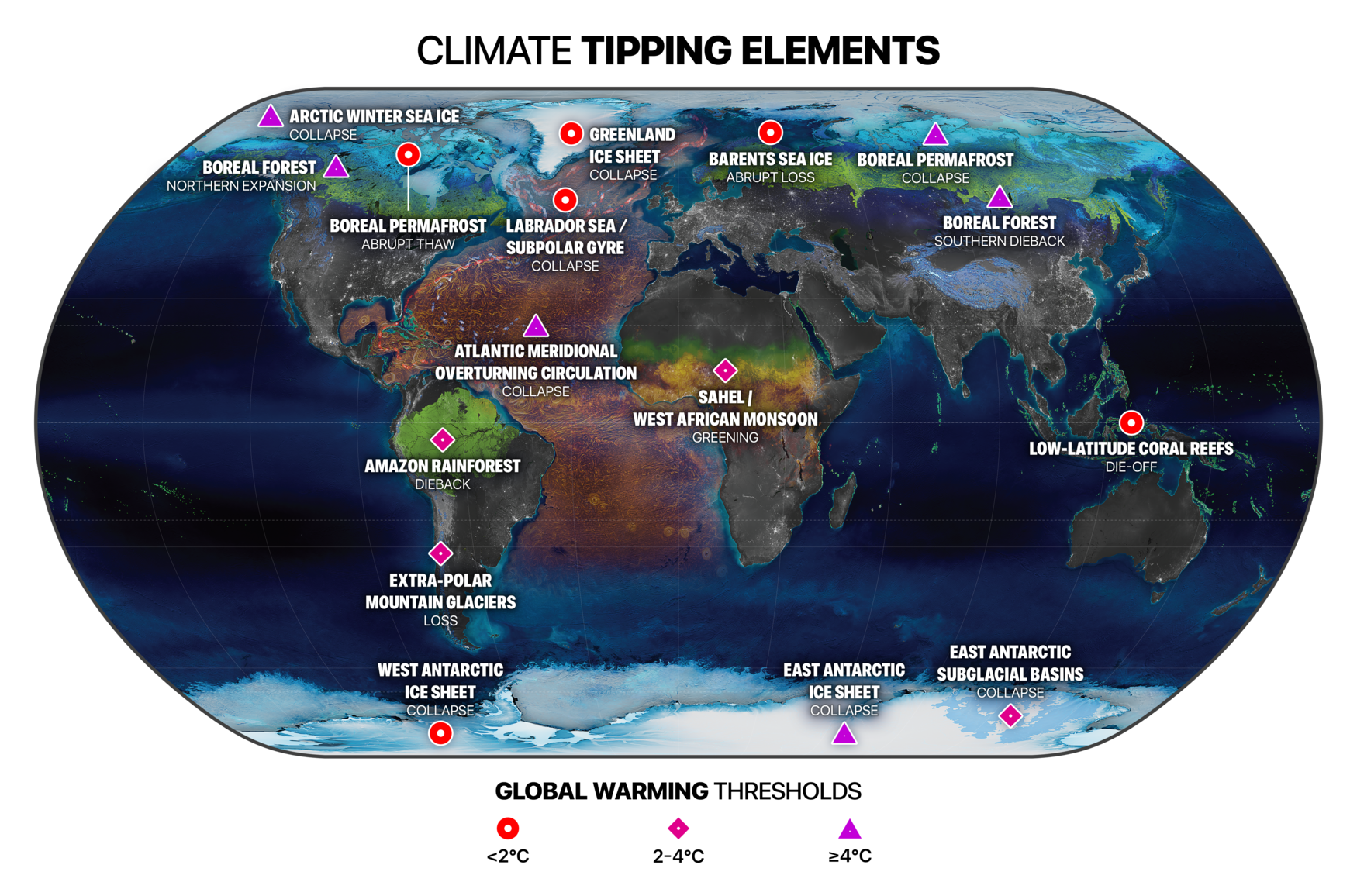
Tipping points are the thresholds for dangerous, and irreversible change in major parts of our Earth system, known as tipping elements. These elements include our planet’s ice masses, circulation systems, and specific ecosystems. Recent research has identified 9 major tipping elements with significant implications for the Earth’s overall function and 7 regional tipping elements with substantial effects on human welfare or unique features of the Earth system.
Reference & Explainer
Why are Tipping Points important?
Crossing tipping points will lead to unprecedented and irreversible damage to our societies and our planet at a global scale. This includes significant sea level rise devastating major coastal cities, dieback of major forests including the Amazon, and disruption of natural rainfall cycles.
With current global warming levels, we are already within the uncertainty range for 5 tipping points. The Paris Agreement’s target range of 1.5-2॰C of warming still puts us at risk of crossing 6 or more tipping points, including ice sheet collapse and widespread permafrost thaw.
Crossing these tipping points will change the world as we know it.
Urgent action is needed to mitigate climate change and other transgressions of Planetary Boundaries, and avoid crossing multiple tipping points.
Feedback loops leading to tipping points in the Earth system
Many natural systems on Earth are governed by feedback loops—processes that either stabilize or amplify changes. A negative feedback works like a balancing mechanism: when something shifts, the system reacts in a way that restores equilibrium. For example, when your body overheats, you sweat to cool down. In the Earth system, more heat can lead to more evaporation and cloud formation, which reflects sunlight and slows further warming. These negative feedbacks help keep the planet stable.
A positive feedback, by contrast, reinforces change and can push a system into a new, often unstable state. For instance, as Arctic ice melts, it exposes darker ocean water, which absorbs more heat and accelerates further melting. Similarly, as forests die back, they release stored carbon, which drives even more warming. When positive feedbacks grow stronger than the stabilizing ones, the system can reach a tipping point—a threshold beyond which change becomes self-perpetuating and difficult or impossible to reverse. Understanding these feedbacks is crucial to identifying where such thresholds lie and how to avoid crossing them.
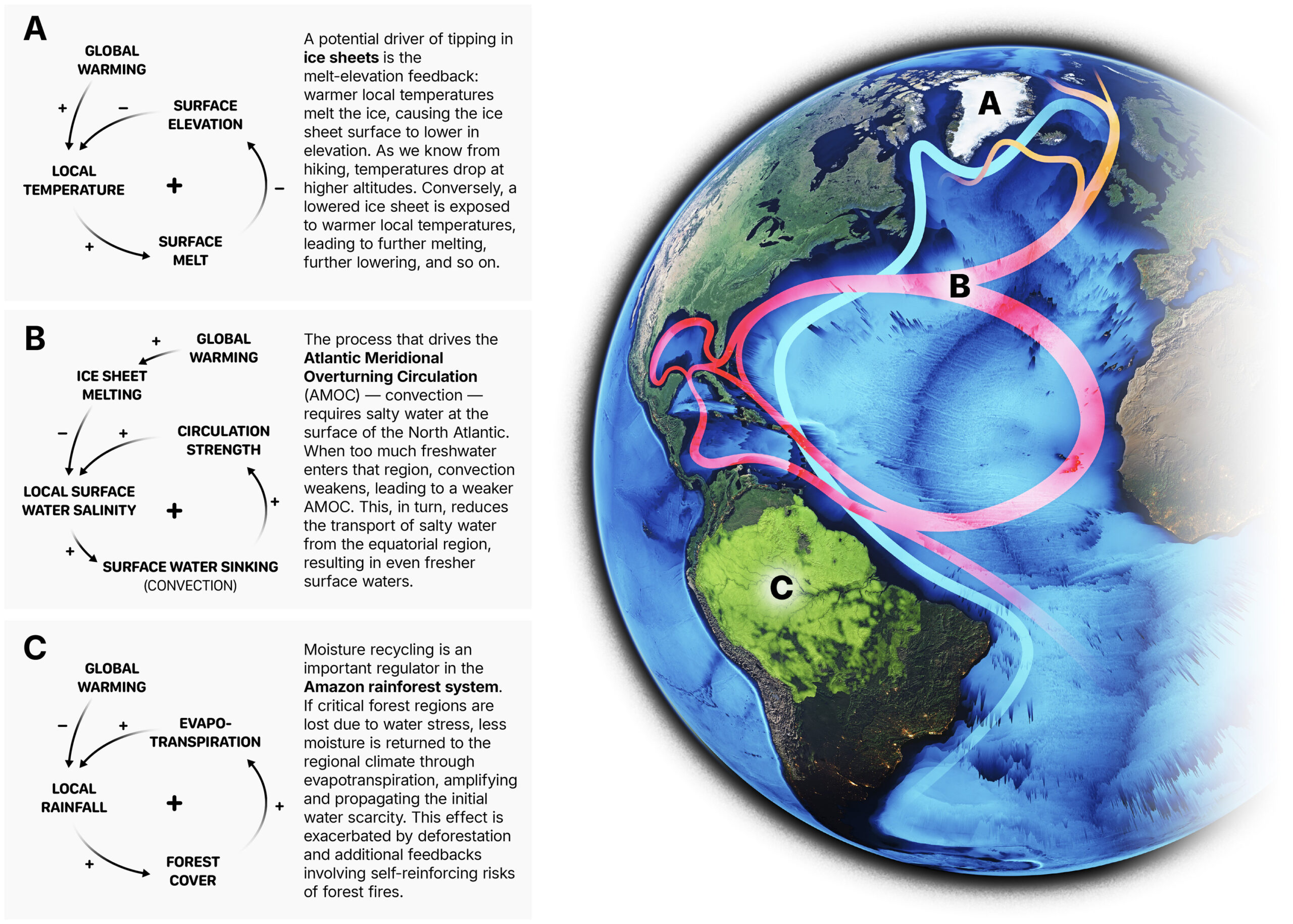
The feedback mechanisms of three major tipping elements are shown here: The Greenland ice sheet (A), the Atlantic Meridional Overturning Circulation (AMOC; B) and the Amazon Rainforest (C). Arrows denote the influence from one element to another: Those marked with a plus show a strengthening influence – e.g., more forest cover leads to more water vapor in the air (“evapo-transpiration”). Minus signs indicate a weakening influence – e.g., more global warming leads to less rainfall.
What links Planetary Boundaries and Tipping Points?
The scientific insights into the increasing risk of destabilizing tipping elements has helped define our Planetary Boundary thresholds. The Boundaries are set to prevent the crossing of tipping points
The risk of crossing tipping points increases significantly between 1 and 2°C of global warming above pre-industrial levels — a temperature range that aligns with the zone of increased risk for the Climate Change Boundary. This overlap underscores the need for proactive measures to prevent irreversible harm to the Earth system, even amid uncertainties.
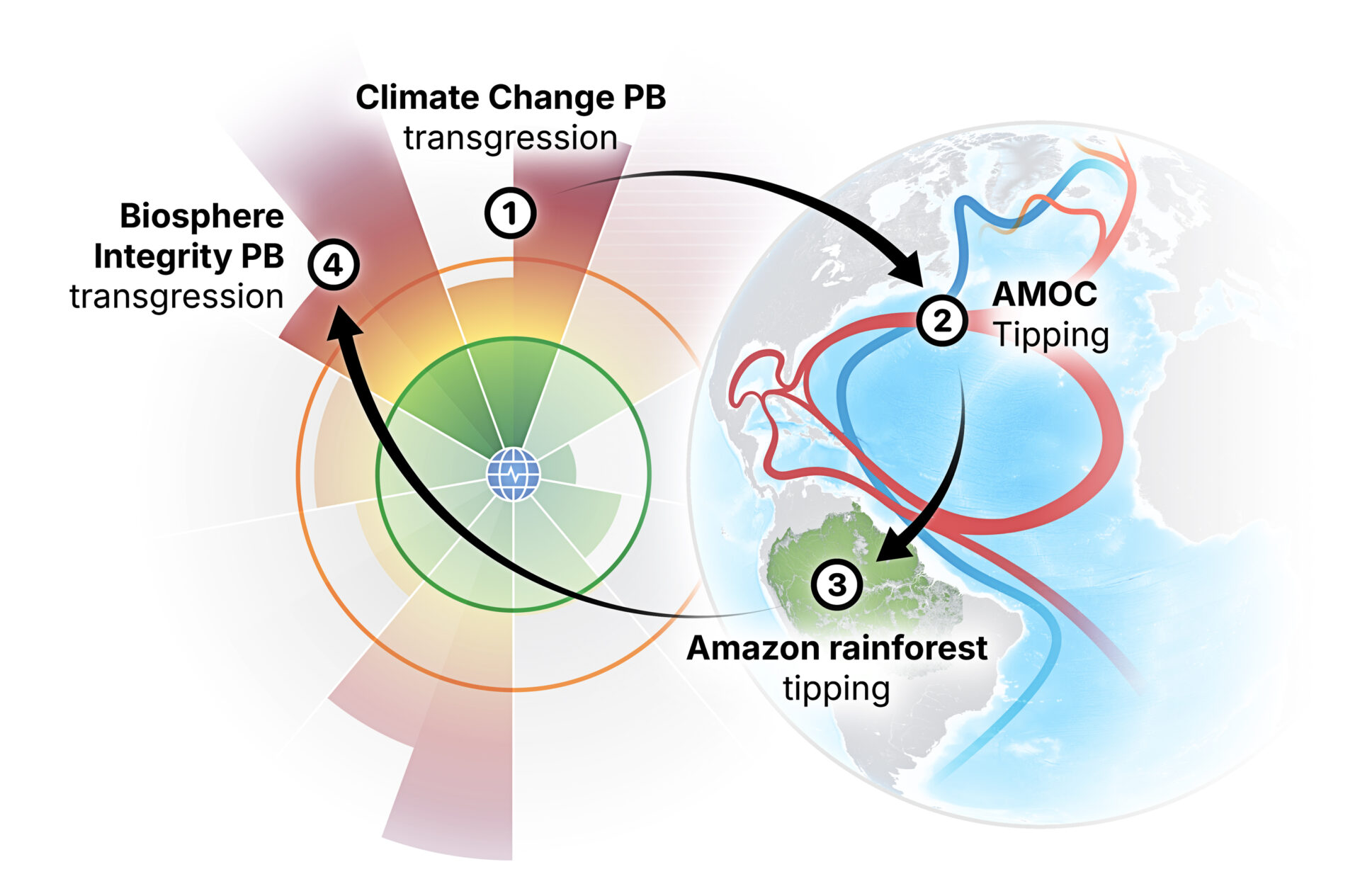
Planetary Boundaries and tipping elements can potentially be linked in a cascade: If a Boundary is breached, tipping points may be triggered. This, in turn, may degrade the state of other Boundaries. For example, increasing Climate Change (1) triggers tipping dynamics in the Atlantic Meridional Overturning Circulation (AMOC; 2). This disturbs the precipitation patterns in the Amazon rainforest (3), leading to a tipping dynamic here as well and degrading Biosphere Integrity (4)